8 June 2012
I'm freezing this blog as read-only, new blog @ ofoghlu.net/blog
As of today I'm freezing this blog as read-only:
http://www.ofoghlu.net/log (Old blog - frozen)
I'll keep all the generated files, with image and other links intact, as I migrate to a new server.
I'll then use a completely new paradigm for maintaining my new blog, that I hope will start to be a bit more regular again, and contain more code snippets. The new tools will make this easier for me:
http://www.ofoghlu.net/blog (new blog - active)
This will use Octopress and Jekyll to manage content. See the first post in the new blog for details.
Migration is in progress, DNS lag means it will take a day to propagate so it points to the new server where the new blog is (I've manually copied the initial sync of the new blog to the old server so the link works in the overlap period).
13 March 2012
Google Scholar Page
I just enabled my Google Scholar Page: Mícheál Ó Foghlú - Google Scholar Citations.
I had previous enabled by ACM personal profile: Mícheál Ó Foghlú - ACM Author Page.
6 March 2012
FeedHenry Brings Mobile App Development to Cloud Foundry
This afternoon I published a guest blog post on the Cloud Foundry website, promoting to use of Feedhenry's new integration with public Cloud Foundry. I re-produce a slightly edited version here. I'll follow up with more details of how to update the server-side of the app that has been created with the instructions below, using git commits.
FeedHenry Brings Mobile App Development to Cloud Foundry
Mobile application developers can now build and deploy applications on Cloud Foundry using the FeedHenry developer platform.
Available today (Wednesday, 6th March 2012) at mobilecf.feedhenry.com, Cloud Foundry developers can build mobile apps using HTML5, JavaScript and CSS fully integrated and instantly staged to their CloudFoundry.com account. To get started, simply download the FeedHenry Command Line tool, using your existing CloudFoundry.com credentials. New subscribers to CloudFoundry.com can join using the promotion code “feedhenry“.
In the following blog we will demonstrate how to use the FeedHenry Command Line tool to clone a sample/template app, (from GitHub), stage the server-side code to CloudFoundry.com (Node.js and Redis), and build a HTML5 & JS app for an Android device. See http://mobilecf.feedhenry.com for detailed instructions. Also check out the FeedHenry App Studio to preview the app that you create here.
Installing node.js
The FeedHenry CLI tool, fhc, uses node.js on your local machine. To setup node.js use the node installer located at http://nodejs.org/#download
Installing or Updating the FeedHenry CLI Tool (fhc)
Use the Node Package Manager (npm) to install or update the FeedHenry CLI tool (fhc).
$ sudo npm install –g fh-fhc(the optional prefix “sudo” gives permission to install system-wide in a Unix style environment).
To test fhc is installed correctly and see the version you have installed, use:
$ fhc -vfhc has some built-in documentation; use fhc help for general help, or fhc help [command] for help on a specific command.
Logging in using your CloudFoundry.com credentials
To get started with the CLI tool you need to login to the FeedHenry platform using your CloudFoundry.com credentials. This will automatically create a FeedHenry account at mobilecf.feedhenry.com.
$ fhc target https://mobilecf.feedhenry.com

$ fhc login <your CloudFoundry.com email> <your CloudFoundry.com password>
In the next 3 simple steps, we will illustrate how to create a HTML5/JS app with an instant backend in cloudfoundry.com
Forking a template app in github (code)
To edit/modify the template app, login to github, and fork the app to your personal account.
https://github.com/feedhenry/App-AnatomyGet the read-only git identifier for your cloned app.
git://github.com/<YOUR-ID>/App-Anatomy.gitNow create an app in the FeedHenry platform linked to your fork of the template app in github.
$ fhc apps create App-Anatomy git://github.com/<YOUR-ID>/App-Anatomy.gitIf using a secured repository, please check out the documentation docs.feedhenry.com for generating and uploading public/private keys.
Staging the backend to Cloud Foundry
Staging to Cloud Foundry requires the use of the unique app identifier <APP-ID> that can be acquired by listing the active FeedHenry apps.
$ fhc appsThe staging can be done to the debug environment or the live environment. The former hosts the server-side for “debug” apps, and the latter for “release” apps. Separating these allows developers to exercise functionality separately in testing before deploying to production.
$ fhc stage <APP-ID> --develor
$ fhc stage <APP-ID> --liveTo ensure that the app has indeed staged correctly use the Cloud Foundry CLI tool (vmc).
$ vmc target api.cloudfoundry.com

$ vmc login

$ vmc apps

$ vmc logs <my Cloud Foundry app-id>
We have just staged the cloud code from our forked app. Each app contains three directories: client, cloud, and shared. The client directory is for the client-side HTML5/JS app, the cloud directory is for the server-side Node.js code (this is what has been staged). The shared directory is in both. Check out the documentation for more information on using the shared directory.
Building the Android client
To generate an Android debug build of the app:
$ fhc build app=<APP-ID> config=debug destination=android version=2.2 download=trueThe appropriate files are gathered, bundled and dispatched to the FeedHenry build farm. The resulting binary file, for Android, an .apk file, is returned and can then be downloaded to your desktop. You can preview the app using the FeedHenry studio at mobilecf.feedhenry.com.
Load the app onto the phone by using email or Dropbox.
That’s it – you have built and staged an app in 3 easy steps.
Note: Editing the code in the git repository can make changes to the server-side and the client-side functionality. Those changes can be uploaded to FeedHenry via a git pull request. The updated server-side code can be re-staged, and the updated client-side code can be used to build a new version of the app. To find out more about this template app, App-Anatomy, see FH App-Anatomy in the References.
To get started go to http://mobilecf.feedhenry.com
Additional information
- Installing vmc: http://start.cloudfoundry.com/tools/vmc/installing-vmc.html
- Installing Node.js: http://nodejs.org/#download
- Installing npm: http://npmjs.org/
- Installing fhc: http://docs.feedhenry.com/our-tools-for-developers/fhc-command-line/
- Cloning an app: http://docs.feedhenry.com/training-labs/fhc/creating-an-app-from-github/
- FeedHenry App-Anatomy: http://docs.feedhenry.com/training-labs/app-labs/app-anatomy/
- FeedHenry Android Build: http://docs.feedhenry.com/training-labs/fhc/creating-an-android-debug-build/
- FeedHenry Staging to Cloud Foundry: http://docs.feedhenry.com/training-labs/fhc/creating-an-android-debug-build/#step3
Join the FeedHenry and the Cloud Foundry guys for a Cloud Foundry mobile meetup, March 25th, San Francisco.
Signup for Cloud Foundry today, and start building your own mobile app!
6 January 2012
Three new PhD Graduates from TSSG at WIT Ceremony
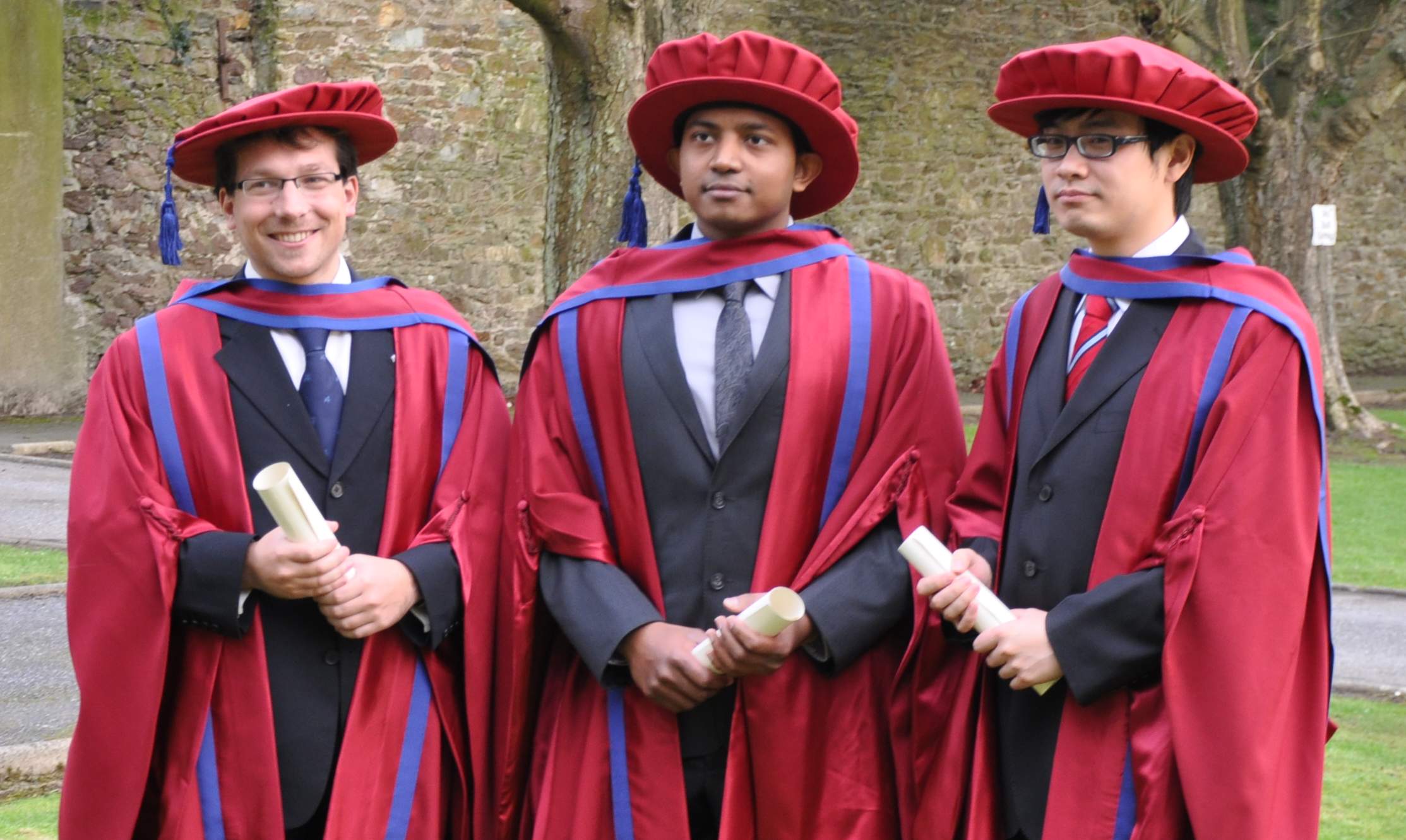
It was my pleasure to attend the graduation ceremony in WIT on Friday 6th January 2012 where three more PhD students graduated from the TSSG. These were (left to right in picture above) Dr Korbinian Frank, Dr Gajaruban Kandavanam and Dr Lei Xu. These join the previous gradutes for a total of eight PhD gradutes from the TSSG to date.
Doctorates represent many years of hard work, comprising persperation and insiration, and I wish all the new graduates all the best.
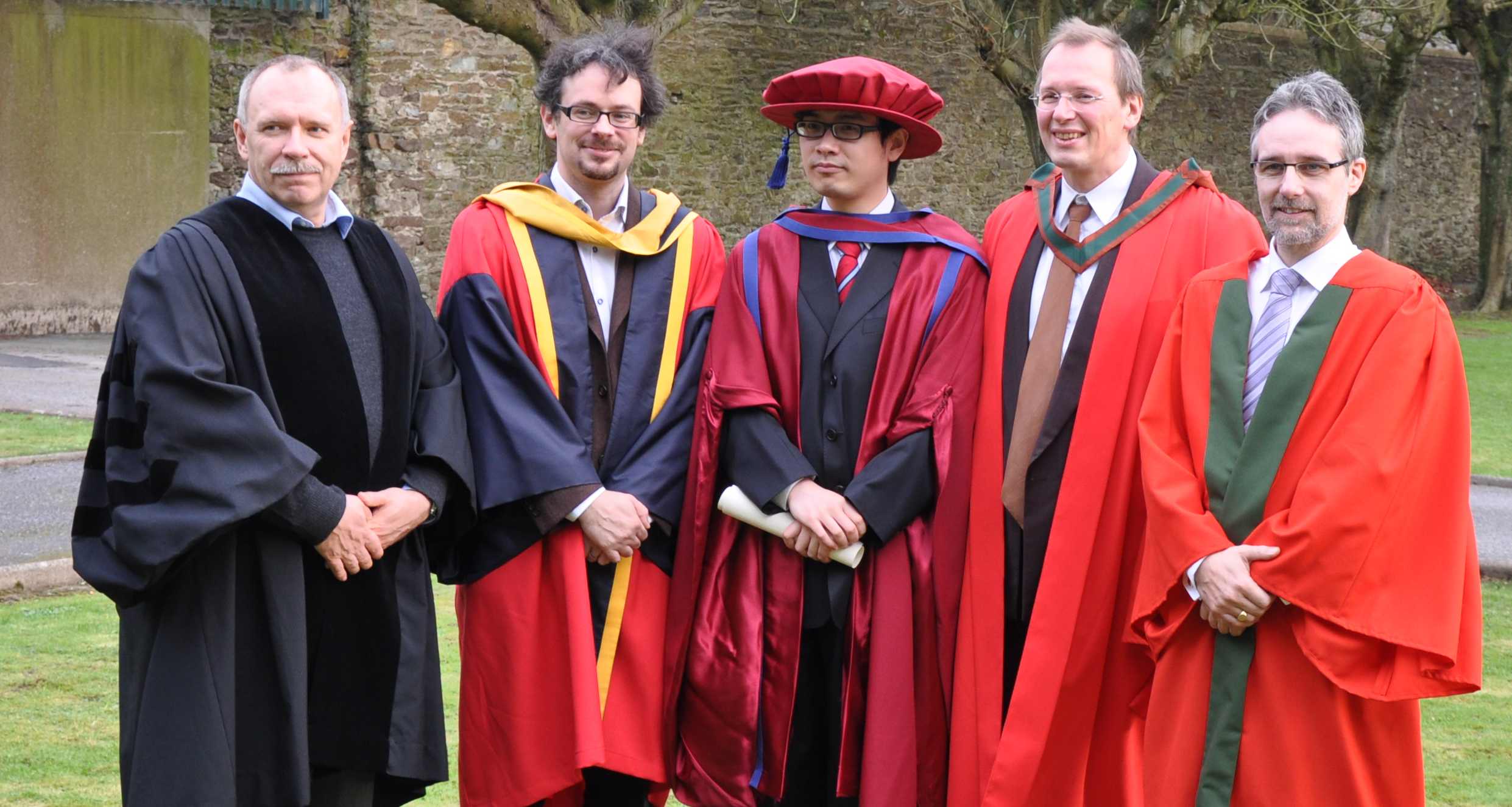
Of course, I should also mention the supervisors for these students, respectively Dr Tom Pfeifer, Dr Dmitri Botvich and Dr Brendan Jennings pictured with Lei below (with me on the far right, Tom to my left, Dmitri on the far left and Brendan to his right). Dr Sasi Balasubramaniam, not pictured, was a co-supervisor of Gajaruban.
In order for these students to graduate many others in the TSSG contributed to supporting the students, and to the funding that helped create the environment where this research could be done. It is interesting that all of the supervision of these students was carried out out by full-time researchers in the TSSG whose funding came from competive basic research grants (HEA and SFI), so the achievment is definitely one of the students, of the supervisors and of the TSSG in general.
26 October 2011
We mourn three giants in October 2011
Three great men have passed away this month, all leave huge influence behind them on humanity and our continued journey in our use of tools. They contributed to the core foundational principles of computing, and to the design of products that led to the widespread adoption of the resulting technologies by the general public. I think software is a very strange thing, that we don't consider too often, layers of abstraction and tools that allow the creation of digital artefacts that change our lives. Of course hardware is needed too, but software itself must surely be studied more in social sciences as one of humanity's most productive inventions, not yet equal to natural language in impact on our history, but harnessing our natural linguistic abilities and turning them towards an engineering purpose - pure magic. Perhaps more accurately software should be seen as the latest incarnation of mathematics, our first artificial language, made alive through the ability to actually execute on hardware. In any case, we stand on the shoulders of giants.

The BBC reported this week on the death of John McCarthy, arguably the founder of Artificial Intelligence (AI), and the creator of LISP, still one of my favourite programming languages. He died 24th October 2011, at the age of 84. See also the Guardian Obituary. AI was my first love in computing, and I have huge respect for the power and simplicity of LISP for exploring this vast field.

Earlier this month, the BBC also announced the death of Dennis Ritchie, creator of the C programming language and co-creator of UNIX at Bell Labs, who died on 12th October 2011. See the Guardian Obituary. I fell in love with UNIX (and the Internet) in the mid-80s in university in Keele, and it has been the stable OS underpinning nearly everything I have done with computing since then, not least the Mac OS X MacBook I am using now to type this blog post. Again it is a powerful and generative tool, based on simple principles.

Perhaps most well covered in the popular press, Steve Jobs of Apple who died at the early age of 56, on the 5th October 2011. Through arguably the most impressive range of product launches in the history of computing, he has driven the adoption of the key technologies in computing by the general public, opening up the excitement and wonder of the potential for these technologies to all of us, not just the academics. See the Guardian Obituary. I love my iPod, iPhone and iPad as well as my OS X machines, and I love the fact that computing was democratised by the personal computer.
We will not see their likes again, to paraphrase what we say in Irish.
3 July 2011
Tall Ships in Waterford

Waterford had a very busy weekend from Thursday 30th June 2011 to Sunday 3rd July 2011 as the quays in the city centre hosted the start of the Sail Training Interational Tall Ships Race 2011.
I was up early on Sunday morning, standing on the green road between Cheekpoint and Passage East, to see the parade of sail as the ships came past to Dunmore East. This Flickr Set of photos captures most of the tall ships as they passed by.
11 June 2011
New C++ ISO Standard, C++0x, reboot
The New C : Lay down your guns, knives, and clubs • The Register
Facinating discussion of how important C++ still is. Wierd that I witnessed it all, from teaching myself OO and C++ on a 286 with Zortech C++ in the mid-to-late 1980s. I still have an original ECOOP conference poster (1988, Oslo, Norway).
World IPv6 Day figures from Google indicate success
Google, Facebook promise new IPv6 services after successful trial
Google said it has decided to leave its main YouTube website enabled for IPv6 for the time being. Since 2008, Google has supported IPv6 on separate websites -- such as www.ipv6.google.com -- rather than on its main websites.
"We saw 65% growth in our IPv6 traffic on World IPv6 Day," said Lorenzo Colitti, IPv6 Software Engineer at Google, who pointed out that Google added IPv6 support to several new services including Orkut for the trial. "This event has really been successful in galvanizing the community."
8 June 2011
Coverage of World IPv6 Day
Tech giants join in World IPv6 Day | IT PRO
World IPv6 Day today

Today is World IPv6 Day, organised by the Internet Society (ISOC). Internet Society - World IPv6 Day.
Read the "About IPv6" section of the Irish IPv6 Task Force website if this means nothing to you :-)
Many people are experimenting with turning on IPv6 for the first time, and/or turning off IPv4 to see if the IPv6 infrastructure can cope.
So today is a good day to test your own machine to see how well it can cope with the next generation internet protocol, IPv6: http://www.testipv6.com.
In Ireland there is a good IPv6 readiness site, http://www.ipv6ready.ie, sponsored by the INEX, the Dublin Internet Neutral Exchange.
The Irish IPv6 Task Force has also a website for the day, http://www.ipv6day.ie, the site includes a monitoring tooolset that monitors IPv6 readiness for high profile public and private sector Irish internet sites.
3 June 2011
Android: FeedHenry Apps
mofoghlu's FeedHenry Apps
4 total, 4 free (100%), 0 paid (0%), 7MB total size, $0 total price
View this Android app list on AppBrain
26 May 2011
HTML5 Last Call May 2011

The next generation of web standards made significant progress this month as the W3C announced that the draft HTML5 specification has been opened up to a "Last Call" for comments from members of the W3C, and the wider community. This is on target for the schedule the W3C set last year for HTML5, and is based on the assumption that the priority is to get a recommended HTML5 specification as soon as possible.
W3C Invites Broad Review of HTML5
16 May 2011

MIT is celebrating 150 years, and they've listed the top 150 things they've done. Top of the list is supporting the World Wide Web Consortium! Well done guys.... good to be top of these lists.
MIT 150: The Top 50 - Boston.com
Semantic Web: RDFa

Whilst attending the World Wide Web Consortium Advisory Committee meeting in Bilbao (on today and tomorrow), I realised that one small part of the semantic web initiative, pushed for many years by the W3C, has started to see wide scale adoption.
RDFa is now claimed to be embedded in 3.6% of all public URLs (October 2010), and growing fast. Yahoo! led the way with SearchMonkey indexing, Google followed with rich snippets, and FaceBook have used it to enable their open graph protocol.
For more information see:
- W3C Pleased With Semantic Web Adoption by Facebook, Best Buy & Others
- Strategies for Building Semantic Web Applications
- W3C RDF Web Applications Working Group
9 May 2011
The China Post: Europe set to put data in the cloud
Europe set to put data in the cloud – Google Apps for Business.
Continue reading "The China Post: Europe set to put data in the cloud"16 April 2011
Mobile OS Market Share (Feb 2011) iCrossing

from iCrossing.
15 April 2011
Facebook usage graphic

from iCrossing.
14 April 2011
Science, Engineering and Technology Research Funding Policy in Ireland 1995-2008: A Policy Document Analysis
My thesis on Irish Research Funding Policy, accepted last summer for a doctorate in the University of Sheffield, School of Education, has been published on the University of Sheffield e-thesis website. This site is shared by the Universities of York and Leeds, and so is called White Rose eTheses Online. It has also been published on the Waterford Institute of Technology repository (i.e. where I currently work).
Ó Foghlú, Mícheál (2010) Science, Engineering and Technology Research Funding Policy in Ireland 1995-2008: A Policy Document Analysis, EdD Thesis, University of Sheffield, School of Education. (University of Sheffield PDF, WIT PDF).
Abstract
In the period 1995 to 2008 there has been an increased level of government funding
for research and development in higher education institutions in Ireland.This thesis analyses the evolving theoretical literature on the production of
knowledge, and traces how models of research and innovation have evolved in the
contemporary period. Four models are discussed: (i) linear model, (ii) national
systems of innovation, (iii) mode-2 science, and (iv) triple helix.The thesis presents a detailed analysis of a series of public documents produced
in Ireland in the period, and discusses how each one relates to the theoretical
background. Some of these relationships are explicit, where documents cite key
authors and the models as discussed in the theoretical literature. Some of the
relationships are implicit, where the manner in which the process of research and
development is described implies that certain models are being assumed.The thesis subsequently discusses the results of this analysis, where it seems
that the Irish policy literature is moving away from an engagement with at least
some of these theoretical models, towards a very operationalised implementation
strategy. This is epitomised by the development of the Strategy for Science
Technology and Innovation.The thesis finally makes a number of recommendations for policy makers,
advising the more detailed study and analysis of Ireland's own national system
of innovation, and the prioritisation of the use of research funding to build up
capabilities in identified areas of this system that are weak.
13 April 2011
Talk at WIT Research Day on Irish Research Funding Policy
I gave a talk today at the WIT Research Day (13th April 2011) on Irish Research Funding Policy, focused on its reference to non-linear theories of Knowledge Production. Draws on my doctoral research that did an analysis of public research policy documents in Ireland 2005-2008. Ireland in this period made the case for huge increases in HERD (funding for R&D in Higher Education), and implemented this from 1998 onwards primarily via the HEA PRTLI and SFI. My case is that this was done without a proper analysis of what impact on the knowledge economy was planned for, or how it could be measured. Now with less money available, we need to revisit the process, make critical decisions, and create clarity for ongoing funding.
The slides area available on SlideShare.
29 March 2011
Nortel, in bankruptcy, sells IPv4 address block for $7.5 million
IGP Blog :: Nortel, in bankruptcy, sells IPv4 address block for $7.5 million. The RIRs have long argued that they assign the IP addresses, and that they are not owned, so I am not sure that this will stand up in the end, but the claim is that Nortel have sold an IPv4 allocation to Microsoft as part of their bankruptcy process.
28 March 2011
Cross-Platform Mobile App Development
Retrospection: Cross-Platform Mobile Development at EclipseCon - Heiko Behrens (Blog)
I met Heiko recently in Kiel, Germany, where we were both presenting our own visions of cross-platform mobile app development to a local chapter of the ACM. I was very impressed with his bredth of knowledge and his analysis of the field.
This blog post covers his most recent session at EclipseCon this month.
Now, in my view, the hybrid approach of using web technologies for the user interface, and generating local code to integrate into the features of the mobile device (camera, local storage, contacts list, accelerometer, compass, GPS, and so on), as FeedHenry does, is the best medium to long term bet. Web technologies have proved again and again that they can solve cross-platform UI issues, and they must be the safest bet. I'd much rather learn standard JavaScript, CSS, and HTML/HTML5, with a few extra local API calls to get at the local device's features, than learn a limited subset of JavaSCript or some new invented DSL language, when developing mobile apps.
2011-03-28 @ 15:42 Heiko Behrens responds:Thank you for the reference, Mícheál.
I fully agree on the long term: As with the desktop mobile web technology eventually will be able to do real time rendering and tight integration with the host system. At the moment though, neither desktop browsers nor their mobile counter parts can even access a webcam or the built-in camera with pure web technology. It will take some time to catch up with native capabilities. And as we go, a significant amount of outdated browsers (such as WP7) ask for compromises.
We'll see what the future holds...
Posted by mofoghlu at 11:24 AM | Semantic Web and Web Technologies
7 March 2011
University of Limerick iPhone app for Diabetes
Interaction Design Centre - Computer Science and Information Systems Department - University of Limerick - Limerick, Ireland
Tag-it-Yourself™ is a journaling platform that supports the personalization of self-monitoring practices in diabetes. TiY is developed at the Interaction Design Centre (www.idc.ul.ie) and is part of a broader research project called FutureCOMM, which is funded by HEA Ireland under the 4th PRTLI program.
The TSSG led the FutureComm project, and UL's IDC were partners. This is a very interesting output of the research programme. Now allI have to do is persuade them to migrate to Feedhenry to allow it work across multiple devices sucha s Android, Blackerry and Nokia WRT as well as iPhone.
4 March 2011
Security is a big issue in mobile apps
Mobile Apps Insecure? - Bank Technology News Article (free subscription required to read article).
As we are discovering in FeedHenry, the security of mobile apps is a big issue, especially in vertical market segments such as finance and healthcare where there is a risk that sensitive data may need to stored temporarily be on the mobile device.
FeedHenry are enabling platform security features to give enterprises the confidence to develop secure solutions in these vertical market segments. These features cover both server side and client side security issues, including encryption.
10 February 2011
Native Apps versus HTML5 - good TechCrunch article
HTML5 Is An Oncoming Train, But Native App Development Is An Oncoming Rocket Ship
This article argues that at best lip service, and at worst derision, is being paid to web apps and HTML5 apps, despite an underying beleif that HTML5 is the way of the future. The debate is summarised in terms of the major platforms: Apple (fully native for iPhone and iPad), Google (half in half for Android), Facebook (fully HTML for Facebook).
FeedHenry's offering is effecively a halfway house between the two, as the FH client API wraps the local device functionality, and allows the resulting app to delivered via app stores as a real app, despite using web technologies rather than native development languages to build.
4 February 2011
Irish IPv6 Task Force Press Release
The IPv6 Forum Worldwide Chapters' Leaders & Experts call for Swifter Move to IPv6
For Internet Sustained growth and Future Innovation
WATERFORD, IRELAND 4th February 2011.
“The Irish IPv6 Task Force joins its affiliate organisations in the IPv6 Forum to call on the ICT industry to respond to the networking needs of the future. Our contribution towards the required migration to IPv6 is the set of online resources we have created, including two sets of videos of summits that provide detailed advice background context, see http://www.ipv6.ie/” says Dr Mícheál Ó Foghlú, Chair Irish IPv6 Task Force and Executive Director Research TSSG, Waterford IT.
The IANA (Internet Assigned Numbers Authority- www.iana.org ) has allocated the last IP address blocks from the global IPv4 central address pool, ending all debates over when this would happen. Several months remain before Regional Registries consume all their remaining regional IPv4 address pools, with recent trends suggesting that Asia, Europe, and North America will exhaust in that order within a month or two on either side of July 1, 2011.
“The Internet has become the global communication network, now is the time to sustain its growth and stability by integrating IPv6. IPv6 adds great value to IPv4” states Dr. Vint Cerf, Honorary Chair, IPv6 Forum.
“The Internet is for Everyone. IPv6 represents the next stage of the Internet's evolution and will help make this vision a reality,” states Lynn St. Amour, President & CEO, Internet Society.
The eventuality of this day was foreseen by the IETF almost 20 years ago, and a replacement was developed. In 1999 the IPv6 Forum was established by the IETF IPv6 Task Force with the mission to educate and promote the new protocol, and now that we have reached the end of the IPv4 free pool, that mission is more urgent than ever. The IPv4 based Internet will not stop working, but it will stop growing, while the IPv6 based Internet is designed to grow for generations to come.
In our daily lives, failure of the Internet infrastructure or restrictions on its capabilities to add new users or support the worldwide economy are no longer acceptable. Therefore, the IPv6 Forum recommends to all people involved in ICT, that now is the time to leverage 2011 and 2012 for planning and rolling out the new version of the Internet Protocol. Enabling IPv6 in all ICT environment is not the end game but is now a critical requirement for continuity in all Internet business and services going forward. Production quality deployments will take time, Starting late and accelerating the process will compromise quality and significantly raise the costs. The last thing that everyone should avoid is to have to rapidly deploy an unnecessarily costly IPv6 infrastructure to sustain growth and communicate with customers, suppliers, and partners.
Transition planning and adoption of IPv6 is now critical to the on-going stability and growth of Internet Protocol based ICT, not only in the public Internet but in every facet of your office, home and mobile electronic existence where TCP/IP and other IP protocols are used. Training, management, support, billing, security and applications development need to be engaged to allow you to be IPv6 ready.
This call is more critical to developing nations that strive to modernize their critical Internet infrastructure making it future proof and protecting their investments.
“The time is now! And resistance is futile,” states Latif Ladid, IPv6 Forum President Senior Researcher at University of Luxembourg, Security and Trust (SnT) Center. Emeritus Trustee, Internet Society.
“Attempting to predict this date has been an interesting challenge over the years, given the chaotic nature of global Internet growth. The challenge ahead for the larger community will be to move past denial, mourning, and grief, and get on with the task of IPv6 deployment,” states Tony Hain, IPv6 Forum Fellow, Technical Director, North American IPv6 Task Force.
“If you think you can ignore IPv6, think again. As new IPv4 addresses cannot be acquired the industry will be faced with customers / partners / suppliers who can only be reached via IPv6. Our industry will need to face the “balkanization” of the Internet. It is time to act and to deploy IPv6 now,” states Yanick Pouffary, NAv6TF Technology Director, IPv6 Forum Fellow and IPv6 Forum (Ready & Enabled) Logo Programs Chairperson.
To test your IPv6 connection and see if the globe is spinning for you, click on this link: http://ipv6forum.org/test_ipv6.php or this link http://test-ipv6.com/
About the Irish IPv6 Task Force
The Irish IPv6 Task Force was established by the Waterford Institute of Technology, HEAnet and the Department of Communications, in 2004. Its membership is drawn from the leading networking and public policy expertise in Ireland including the public sector and academic networks, telecommunications companies, online services companies and general enterprise. Since it was formed it has promoted within Ireland the issues relating to IPv4 depletion and IPv6 migration, including organising two successful IPv6 Summits in 2009 and 2010, the videos and presentations are available online http://www.ipv6.ie/summit2010 and summit2009. The Task Force encourages companies to plan for IPv6 deployment as a matter of urgency, and has provided freely reusable online training materials to help with this engagement.
About the IPv6 Forum
The IPv6 Forum is a world-wide consortium of leading vendors, Internet service vendors, National research & Education Networks (NRENs) and international ISPs, with a clear mission to promote IPv6 by improving market and user awareness, creating a quality and secure Next Generation Internet and allowing world-wide equitable access to knowledge and technology. The key focus of the IPv6 Forum today is to provide technical guidance for the deployment of interoperability thru its IPv6 Ready & Enabled Logo Programs :www.ipv6ready.org & http://www.ipv6forum.com/ipv6_enabled/
http://www.ipv6forum.com
For further information, please contact:
Dr Mícheál Ó Foghlú,
Chair, Irish IPv6 Task Force
Executive Director Research, TSSG, Waterford IT
Tel: + 353-51-302963
mofoghlu att tssg.org
2 February 2011
Excellent Netscape documentary from 1998-99
I just read an interesting blog post from Jeff Atwood Coding Horror: Lived Fast, Died Young, Left a Tired Corpse (thanks to @rjroger)
The post has links to the documentary film of Netscape pushing to release open source with a tight deadline: Code Rush. For a very long time, Code Rush was almost impossible to find, but the activism of Andy Baio nudged the director to make the film available under Creative Commons.
It is salutary to see the development environment that drove one of the lasting legacies of the original dot com bubble, I am typing this in a Firefox (Mozilla) browser window using a MovableType Perl backend CMS, all technologies of that era, the open source Firefox being the direct legacy of Netscape. I am CTO of FeedHenry, a company that is basing its mobile app strategy on JavaScript, another legacy of that era. What comes around goes around.
1 February 2011
World IPv4 Stocks Finally Run Out
IANA, the Internet authority, has assigned its last batches of IPv4 addresses to the RIRs (Regional Internet Registries), putting pressure on companies to adopt IPv6. See the Irish IPv6 Task Force for more information, particularly the last two Irish IPv6 Summits in 2010 and 2009, lots of good slides and videos on-line.
Geoff Huston's prediction model now cites only the next projected deadline, when RIR's allocation will run out. His prediction model for the IANA /8 pool, that I have been tracking since 2005, has now reached its reality checkpoint: 1st Feb 2011.
So in a very real way today marks the beginning of the end of the Internet as we know it. This morning, the Internet authority IANA allocated two batches of IPv4 addresses to APNIC, the regional Internet registry of the Asia Pacific, leaving just five batches (known as /8s) in the global pool.
Some time ago, the Regional Internet Registries (RIRs) agreed that, when IANA got down to the last five /8s, IANA would allocate them automatically to the five RIRs, regardless of whether or not those registries needed more IP addresses at the time. That day has arrived, meaning that IANA’s stock of IPv4 addresses is now fully depleted.
I am tempted to say "The end of the world is neigh!" but in fact things will continue much as normal for some time. The point is that when the RIRs run out, that's it, no more IPv4 (or very expensive recycled IPv4). So we have probably less than one year to migrate to IPv6, if want the Internet to continue to be able to grow. Of course this is not feasible, so we are now pretty much guaranteed a messy overlap period of a fully allocated IPv4 Internet that cannot grow any further co-existing with a fresh new IPv6 world that has not yet grown to be the same size, but will do so over time (years? decades?). I really hope we can push people to migrate quickly, as I like the idea of an Internet that can grow, and I hope you do too.
Please Act Now!
Update 2011-02-03
And I'm quoted here: Silicon Rebublic, Internet to run out of available IP addresses tomorrow (based on what was said at the previous Irish IPv6 Summit in May 2010).
28 January 2011
Daniel Karrenberg's facinating article in similarities between Internet industry and Financial industry

The ISP Industry and the Financial Sector - Amazing Similarities
A really interesting article, as you can see from the diagram.
In the last RIPE Labs article on this subject How Does the Internet Industry Compare?, we looked at ways to compare our industry with other industrial sectors, and identified a number of characteristics that an industry must have in order to be comparable to the Internet industry. It seems the financial sector or monetary credit industry shares many of these characteristics and in fact behaves much like the Internet industry.The three main factors that determine the cumulative distribution of resources in both industries are:
- centrally administered coordination policies
- commercial strategies and competition between each industry members determines how fast each of them grows
- the absolute size of the user base and the varying demands of individual users.
Posted by mofoghlu at 12:48 AM | Telecoms and Networking
26 January 2011
TSSG's new building has an energy efficient data centre

The Telecommunications Software and Systems Group (TSSG) at Waterford Institute of Technology has a new energy–efficient data centre to support its network-based research projects in the area of telecommunications networking.
Right now, TSSG is working on an average of 40 to 50 research and development projects. It has been recognised as one of the top 10 European institutes driving ‘future internet’ research.
Kedington Group has designed the centre at TSSG, which has an IT power load of 300Kw, with some cabinets engineered to house 30kw of IT equipment. It deployed Rittal LCP technology, which uses chilled water (at 15°C) and will provide free cooling 72pc of the time, for the new data centre.
18 January 2011
W3C Unveils HTML5 Logo
The W3C have unveiled a HTML5 Logo: W3C News Archive: 2011 W3C
W3C unveiled today an HTML5 logo, a striking visual identity for the open web platform. W3C encourages early adopters to use HTML5 and to provide feedback to the W3C HTML Working Group as part of the standardization process. Now there is a logo for those who have taken up parts of HTML5 into their sites, and for anyone who wishes to tell the world they are using or referring to HTML5, CSS, SVG, WOFF, and other technologies used to build modern Web applications. The logo home page includes a badge builder (which generates code for displaying the logo), a gallery of sites using the logo, links for buying an HTML5 T-shirt, instructions for getting free stickers, and more. The logo is available under "Creative Commons 3.0 By" so it can be adapted by designers to meet their needs. See also the HTML5 logo FAQ and learn more about HTML5.
The logo itself is not the main important thing, it is the richness of HTML5's features that help make media (audio and video in particular) easier to access in a standardised way on the web.
HTML5 also promises to help level out the differences between the various mobile devices, providing a common web-based layer of functionality that can be targeted by all mobile apps. Currently companies like FeedHenry (where I am CTO) offer a client-side API abstraction that helps cross-platform mobile app development and deployment, utilising web technologies. HTML5 will hopefully make more of these differences irrelevant over time, making it even easier to develop cross-platform mobile apps that work across a wide range of devices, using standardised web technologies (approved by the W3C).
The TSSG (where I am Executive Director Research) are members of the W3C and support these standardisation activities.
UPDATE 2011-02-21 Ian Jacobs of the W3C has blogged on the interesting discussions the unofficial release of the logo to the public has generated, see Ian Jacobs' Blog Entry.